
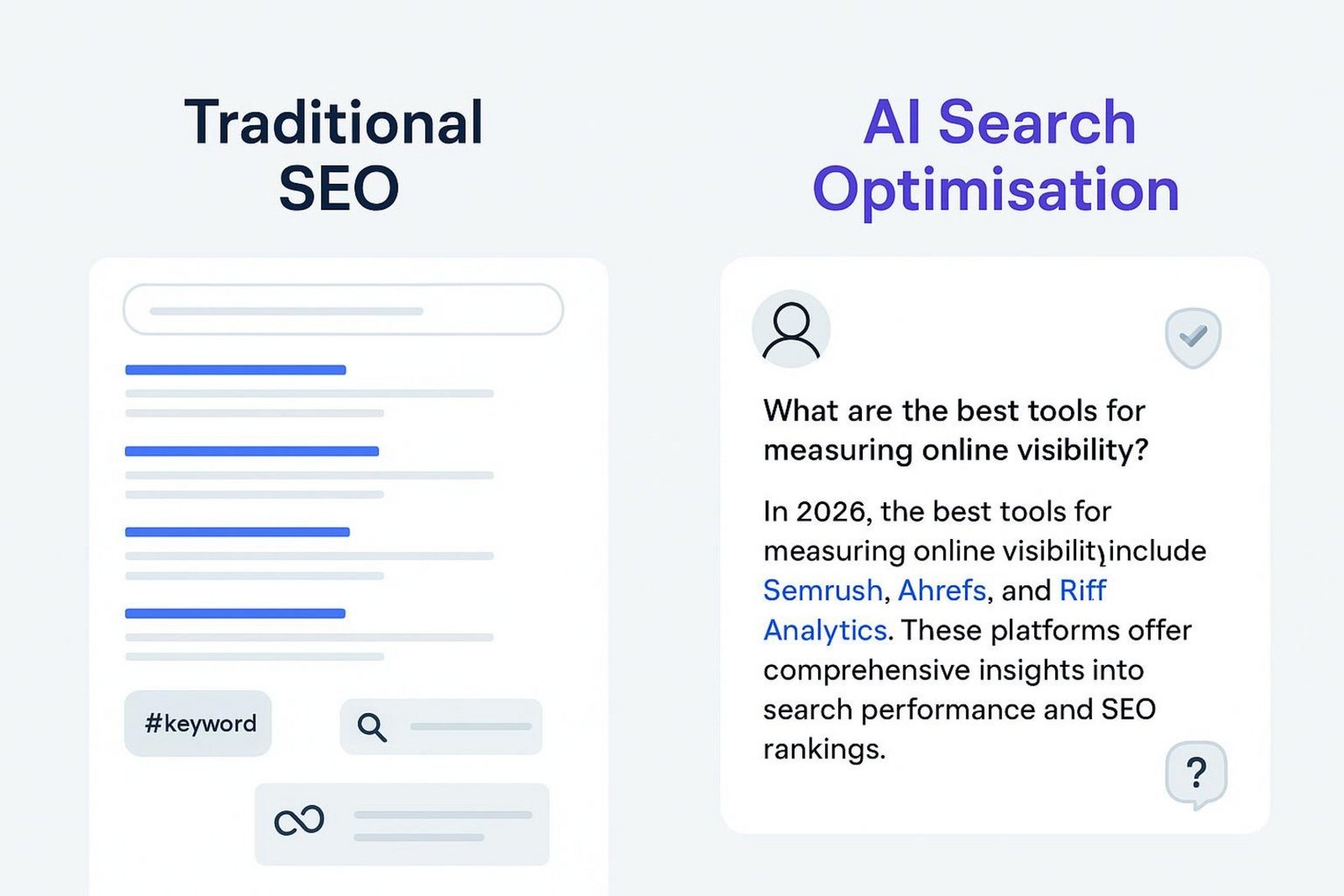
In high-pressure, crowded markets, AI search optimisation solutions are the systems and tools that help a brand stay visible, mentioned, and recommended by generative AI platforms. Instead of only chasing a spot in a list of blue links, these solutions aim to influence the full answers given by tools like ChatGPT, Perplexity, and Google’s AI Overviews. For companies in busy sectors, this is a key shift from trying to “rank” to becoming the preferred authority in AI-driven conversations.
As we move through 2026, online search is shifting to a “show, ask, and refine” model. Old tactics on their own no longer work when nearly 75% of searches are expected to be shaped by AI summaries in the coming years.
Putting a strong AI Search Optimisation strategy in place lets companies own the new “front door” of the internet, turning AI-led discovery into steady, high-intent traffic and sales.
What Is AI Search Optimisation for Competitive Industries?
AI search optimisation-often called Generative Engine Optimisation (GEO)-is the practice of shaping digital content so Large Language Models (LLMs) can easily read, understand, and trust it. In competitive areas like finance or SaaS, where every click can be worth a lot, this goes far beyond keyword use. It calls for a clear view of how AI systems pull in information and blend it into a final answer for the user.
For competitive industries, these solutions connect a brand’s data with the AI’s training and retrieval process. By offering clear, verifiable, and well-structured information, companies raise the chance that when someone asks for the “best enterprise CRM” or the “most secure digital bank,” the AI has solid proof to name their brand. It is about building a strong “citation core” so your brand becomes a go-to reference for the model.
How Does AI Search Differ from Traditional SEO?
Traditional SEO relies on keywords, backlinks, and technical setup tuned to a ranking system. AI search is driven by meaning and intent. SEO tries to get you to #1 in a list; AI search aims to make you the main source behind a full, paragraph-style answer.
Classic search engines mostly index links, while generative AI tools build full responses by breaking bigger questions into many smaller ones, often called query fan-out.
AI search platforms are also much more personal. A Google results page is often similar for many users, but an AI chat answer can change a lot based on a person’s past questions and preferences.
This change pushes brands away from static keyword goals and toward “entity-first” content that clearly shows how your brand, your products, and the problems you solve are linked, and does so in a way that stays consistent across many different conversations.
Why Are Competitive Industries Adopting AI Search Solutions?
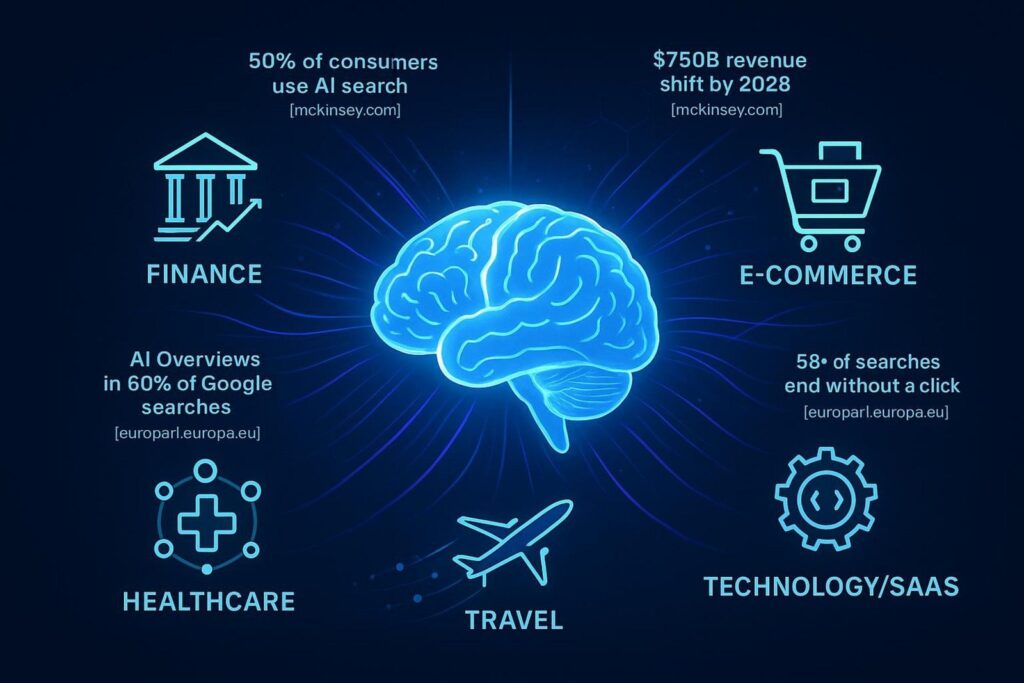
The main reason is the growth of “zero-click” search. With AI Overviews showing on most informational queries, organic clicks on traditional links are expected to drop sharply—some forecasts say by 18% to 64%. For a business in a tight market, losing that traffic without showing up in AI answers can quickly lead to decline.
To combat this, companies aiming for global reach must pivot toward local-first expertise and strategic visibility provided by https://non.agency/en/, ensuring their brand remains the primary choice in every territory.
AI-referred traffic also tends to convert much better—often more than four times better than standard organic traffic. Users who ask AI tools questions are usually further along in their buying journey and ask focused, detailed questions. By being the cited answer in these in-depth exchanges, brands in competitive industries can cut through the clutter of a normal results page and connect with highly qualified prospects.
Key Benefits of AI Search Optimisation Solutions
A clear early benefit of these solutions is keeping your “share of voice” when blue links are pushed lower on the page. When an LLM quotes your brand, you gain a sense of endorsement that regular ads or organic listings cannot match. This kind of “referral” from an AI assistant builds quick trust with users.
These solutions also help guard against misinformation. In busy markets, AI models can hallucinate or draw from old, low-quality sources like outdated forum posts or inaccurate news. A strong AI search plan lets a company feed the web with fresh, reliable data that the AI is more likely to use in real-time retrieval, lowering the risk of wrong or harmful mentions.
Improved Accuracy and Search Relevance
AI search optimisation solutions use Natural Language Understanding (NLU) to match content to the user’s real intent. In sensitive fields like healthcare or law, where precision matters, AI models are better at working out the reason behind a question. By shaping content for these models, companies can focus on getting the most relevant, valuable traffic-not just more visits.
This relevance comes from semantic matching. Instead of matching only exact words, the AI looks at “vectors”-number-based representations of ideas. When your content is rich in meaning and covers a topic in depth, the AI sees your site as a strong relevance point, lifting your chances of being cited for many related, long-tail queries.
Scalability in Fast-Moving Markets
In sectors where prices, trends, and rules change every day, manual SEO updates are often too slow. AI search tools usually include automation that can scan large datasets and refine site signals in real time. This helps companies stay “fresh,” which is a key tiebreaker for AI models deciding between two strong sources in a competitive niche.
Scalability also affects content output. AI-led tools can spot “content gaps” by checking which topics competitors are cited for and which user questions still lack strong answers. This helps marketing teams create modular, high-value content fast enough to stay ahead of rivals, while still keeping the depth and clarity that LLMs expect.

Faster Adaptation to Search Algorithm Updates
Search systems no longer update just a few times a year; they shift almost daily with machine learning. AI search optimisation tools rely on predictive analytics to spot coming changes. By tracking how AI models are retraining and which sources they begin to trust more, businesses can adjust their content plans before a major “core update” lands.
This forward-looking approach matters for competitive sectors where a sudden loss of visibility can mean huge revenue losses. Instead of chasing every algorithm change, these solutions help brands align with the main aim of search platforms: serving the most helpful, human-focused, and trustworthy answer.
Core Features of Leading AI Search Optimisation Tools
Leading tools go beyond basic keyword rankings. They provide “AI Share of Voice” reports that show how often your brand is mentioned on ChatGPT, Claude, Gemini, and other platforms. They also surface “Narrative Driver” insights-showing which questions and themes are pushing users toward your competitors instead of you.
Many tools also include “technical baseline” checks to confirm that your site is not only readable for people but also easy for AI crawlers like GPTBot or PerplexityBot to access. If your server is slow or crucial content sits behind heavy JavaScript, these tools will flag it as a barrier to AI citations.
Machine Learning for Search Intent Prediction
Modern tools use machine learning to go beyond what users type and get closer to what they really want. By tracking patterns across millions of AI prompts, they can guess the next likely question a user will ask. For a competitive brand, this means you can build content that answers the first question and the next three follow-ups the AI is likely to create.
This prediction is especially useful for product discovery. If data shows that users who ask about “warmest winter jackets” usually follow with “under $300” and “machine washable,” the AI will favor sources that provide all three details in a clear, easy-to-extract format.
Content Optimization Algorithms
Content optimization algorithms scan your existing pages and suggest changes to make them more friendly to LLMs. That may mean turning a long, flowery paragraph into a tight “answer capsule” of 40-60 words, or adding a comparison table. AI models prefer content that is already broken into short, modular chunks.
These tools also measure “semantic density” to check you are using related ideas and terms, not just repeating one keyword. For example, a “cloud security” page should naturally mention “encryption,” “zero-trust architecture,” and “latency” to look like a real expert source in the eyes of an LLM.
Automated Technical SEO Audits
Technical health is still the basic requirement for AI visibility. Automated audits in AI search tools focus on items like robots.txt-to confirm AI crawlers are not blocked by mistake-and on the setup of llms.txt. This newer standard gives a clear, Markdown-based map of your site aimed at Large Language Models.
# robots.txt – Allow specific AI crawlers
User-agent: GPTBot
Allow: /
User-agent: Claude-Web
Allow: /
User-agent: PerplexityBot
Allow: /
# llms.txt – A conceptual map for language models
User-agent: *
## Key Content Pillars
– Title: AI Search Optimisation Solutions for Competitive Industries
– Path: /blog/ai-search-solutions/
– Summary: An expert guide on how brands in competitive markets can win visibility in AI answers.
– Title: Our E-commerce AI Search Case Study
– Path: /case-studies/ecommerce-ai-search/
– Summary: Shows how we increased AI citation share by 45% for a major online retailer.
These audits also put strong weight on speed and mobile usability. Since many AI crawlers fetch content straight from the server without running JavaScript, the audit checks that your main content appears right in the raw HTML. This reduces the risk that the AI gives up before it reaches your key insights.
Real-Time Competitor Analysis
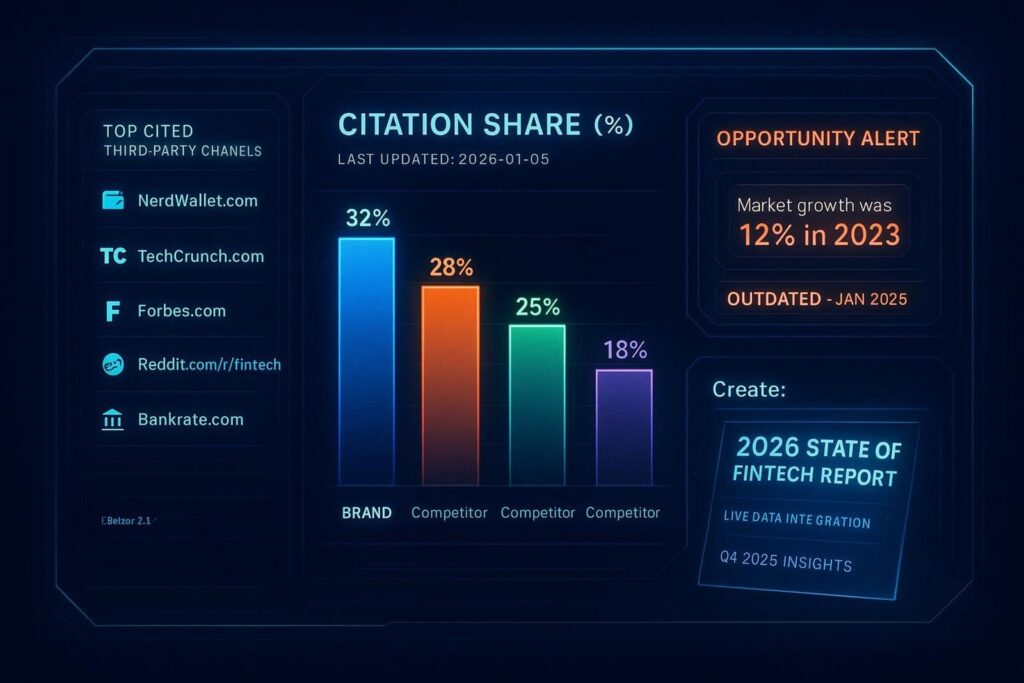
In a tight market, knowing only your own metrics is not enough. AI search tools let you track competitor citations in real time. You can see which outside sites (such as Reddit, Quora, or industry blogs) the AI uses to support your competitors. With this view, you can target those same high-impact third-party channels for PR or guest content.
By spotting where a competitor holds a “monopoly” on an AI answer, you can find weak spots in their content-like old stats or missing real-life examples-and then build a better resource that the AI is more likely to favor over time. This sets up a constant cycle of improvement that keeps your brand ahead.
Personalised Results for User Segments
Advanced solutions help brands see how they show up for different user groups. A FinTech brand, for example, might be a “top recommendation” for “tech-savvy millennials” but missing for “retirees.” AI search tools can simulate these different user histories to reveal gaps in how the brand appears to each group.
Once gaps show up, the brand can create focused content clusters that match the concerns and language of those missing segments. This builds a broad, strong presence across all key customer groups, instead of being stuck in a single niche.
AI Search Optimisation Strategies for Highly Competitive Markets
In very competitive spaces, a “spray and pray” content plan no longer works. Winning now requires a precise focus on “Entity Authority.” Your brand needs to be tightly linked to the main ideas of your industry in the AI’s view. If you sell “sustainable coffee,” your brand name should often appear online alongside terms like “fair trade,” “organic,” and “compostable packaging.”
You also need strong “Answer Packaging.” This means shaping content so AI tools can easily lift it into their answers. Each H2 or H3 should stand as a direct answer to a likely question, backed by data, expert comments, and clear definitions. If the AI cannot use your content as a ready-made quote, it will rarely cite you.
Tailoring Long-Tail Keyword Strategies with AI
The old approach of targeting simple terms like “blue widgets” is fading. Users now ask AI tools things like, “What are the best blue widgets for a small apartment with low natural light?” AI search solutions help you find these very specific, conversational long-tail phrases. These searches face less competition but carry much stronger buying intent.
To win them, your content must be “context-inclusive.” Write sentences that still make sense if the AI pulls them out of the page. Instead of “It is the best in the market,” write “[Brand Name] is the best blue widget for low-light apartments because of its [Specific Feature].” This keeps your brand tied to the insight when the AI extracts a snippet.
Structuring Content for Enhanced Visibility
LLMs tend to favor a “Definition → Detail → Example” pattern. Begin each section with a short, clear answer to the heading. Follow with how it works and why it matters, and then add a real example or data point. This steady structure makes it easy for AI to link your content to user intent.
Use “Modular Content Blocks.” Treat each H2 as if it could stand alone. Include enough context in that one section so the AI doesn’t need to scan the whole page to grasp the point. This boosts the visibility of your entities and helps AI assign your page to the right subtopics with confidence.
Leveraging AI for Data Markup and Schema
Schema markup is like a handshake between your site and the AI’s Knowledge Graph. Beyond simple Organization schema, strong brands use FAQPage, HowTo, and Review schema. This clearly labels your content and tells the AI, “Here is a question, and here is the trusted answer.”
More advanced setups use sameAs fields in JSON-LD to connect your brand to known entities like your Wikidata page or major social profiles. This network of links backs up your credibility for the AI. It works like a machine-readable list of sources that proves your identity and authority.
<script type=”application/ld+json”>
{
“@context”: “https://schema.org”,
“@type”: “Organization”,
“name”: “Your Brand Name”,
“url”: “https://www.yourbrand.com”,
“logo”: “https://www.yourbrand.com/logo.png”,
“sameAs”: [
“https://www.linkedin.com/company/yourbrand”,
“https://twitter.com/yourbrand”,
“https://en.wikipedia.org/wiki/Your_Brand”,
“https://www.wikidata.org/wiki/Q1234567”
]
}
</script>
Building E-E-A-T with Artificial Intelligence
Google’s E-E-A-T (Experience, Expertise, Authoritativeness, and Trustworthiness) is a key standard for AI citations. To build it, your content should have clear authorship with named experts and real credentials. AI models look for steady bylines across the web to decide whether a source is truly expert.
You can also use AI to track your “sentiment” across the web. If forums or review sites lean negative, AI models will be less willing to recommend you. AI search solutions highlight these “reputation gaps” so you can join the conversation, improve customer experience, and gain positive mentions that act as trust signals.
Industry Applications: Where AI Search Optimisation Drives Competitive Advantage
All sectors feel the impact of AI search, but some see stronger effects. These often include “Your Money or Your Life” (YMYL) industries, where accuracy and trust matter most. In such areas, being the main answer is more than a marketing win; it supports the company’s full value promise.
Industries with high “research friction”-where people used to browse many sites before choosing-are also changing fast. AI search removes much of that friction by blending those many sources into one answer. If your brand is not part of that single AI-built answer, you are cut out of the user’s decision path.
Finance and Banking
In finance, users ask AI about mortgage rates, investments, and card comparisons. Since these topics are tightly regulated, AI models are very careful with sources. They favor “Expert Reviewed” content and sites with long-standing domain strength.
Leading banks use AI search solutions to keep their “Product Specification” data current in AI indexes. By using real-time IndexNow updates and strong structured data, they improve the odds that when someone asks for the “lowest APR for a travel card,” the AI points to their newest offer rather than an old competitor rate.
E-commerce and Retail
E-commerce is one of the most changed sectors. Users now ask, “What’s the best eco-friendly yoga mat for someone with knee pain?” To win such searches, a retailer needs more than a product list. They need buying guides, comparison tables, and rich user reviews that AI can easily read.
Retailers are also preparing for “Visual and Multimodal” search. When users snap a product photo and ask AI for “something similar but cheaper,” brands with strong image alt-text and intent-based metadata are more likely to capture the sale. This is the new version of impulse buying in an AI-led world.
Healthcare and Pharmaceuticals
Healthcare is a major test case for E-E-A-T. AI tools like Google’s AI Overviews give priority to trusted sources such as the Mayo Clinic or WebMD. For private providers or pharma brands to compete, they must publish “high-salience” content backed by original research and peer-reviewed work.
AI search solutions help these organizations find “unmet informational needs”-patient questions big medical sites may not cover well. By building the most “helpful” and “human-focused” content for these specific topics, smaller brands can gain a strong share of voice in AI results.
Travel and Hospitality
Travel is shifting from generic “Top 10” lists to “Personalized Itineraries.” A user might ask, “Plan a 3-day trip to London for a family of four who loves history and needs gluten-free options.” To appear in that plan, a hotel or restaurant must have clear “Entity Signals”-location, amenities, diet options-listed consistently across travel sites and reviews.
Competitive travel brands work on “Co-occurrence.” They aim to have their hotel or service mentioned often with terms like “family-friendly” and “gluten-free” in independent content. This helps the AI connect their brand with those needs, boosting the chance of recommendation.
Technology and SaaS
For SaaS firms, AI search acts like a new “Product-Led Growth” channel. Developers and IT leaders ask AI tools for code examples, integration steps, and product comparisons. If your docs are broken into “atomic Q&A blocks,” AI systems can rely on your official documentation for accurate technical answers.
SaaS brands also watch for “Brand Drift.” This occurs when AI tools describe features incorrectly or tie the brand to an old version of the product. By spotting this early, companies can update documentation and communications to correct the AI’s picture of their software.
Evaluating and Selecting AI Search Optimisation Solutions
Picking the right solution means balancing “Software” and “Strategy.” Tools like Semrush or Ahrefs supply data, but a specialist agency often needs to turn that data into a smart content plan. Look for partners who can show past success in getting brands cited in AI Overviews and Perplexity.
Budget also matters. Options range from free basic trackers like OmniSEO to high-end systems like Evertune that cost thousands per month. The right choice depends on how much of your revenue depends on search traffic. If half of your visitors come from search, spending on a premium AI solution quickly becomes a form of protection for your income.
What Criteria Should Be Considered?
Start with “Model Coverage.” Check whether the tool tracks visibility across all major LLMs (ChatGPT, Gemini, Claude, Perplexity), not just Google. As users spread their search across more tools, you need a broad view of how your brand appears across this whole AI layer.
Next, examine “Actionability.” A tool that only says your visibility is “low” is not useful. You need detailed “Prompt-Level Recommendations” that specify which paragraphs to change and which schema types to add. The best platforms provide a ranked list of tasks your content team can act on right away.
Comparing Popular AI Search Optimisation Tools
By 2026, tools tend to fall into two groups: “All-in-One Toolkits” and “Specialized Trackers.” Semrush’s AI Toolkit is popular with marketing teams because it blends AI visibility data with classic SEO stats, giving a combined view of search performance during this period of change.
Specialized tools like Otterly.AI or Profound focus on “Answer Engine” results only. They offer deeper sentiment tracking and “Citation Authority” scores, which matter a lot in PR-heavy fields. For brands focused on protecting their name and reducing AI hallucinations, these niche tools often work best.
Risks and Challenges of AI Search Optimisation
The biggest risk is the “Black Box” nature of AI systems. Unlike traditional SEO, where we have decades of reference, AI search rules are still forming. What works now-like shorter content snippets-may lose impact later as models improve at reading longer, more complex content.
Another issue is “Model Volatility.” AI models retrain often, and one update can erase many of your citations overnight. This makes AI search a channel that needs constant care. You cannot just set up content and walk away; you have to keep watching and refining if you want to hold your place in AI answers.
Potential Overdependence on Automation
AI tools are excellent for finding gaps, but using AI alone to write your content is risky. Google and other engines now have strong filters for low-quality, generic AI text. To earn citations, your pages need “Information Gain”-new facts, unique views, or expert input that generic AI models cannot easily produce.
Too much automation can also flatten your brand voice. If every competitor uses the same AI systems to optimize for the same models, content across brands starts to look and sound the same. Winners use AI for the “science” of structure while keeping humans in charge of the storytelling, examples, and tone.
Data Privacy and Security Concerns
As brands send more data into AI search tools, privacy concerns grow. Marketing teams must make sure confidential business data or sensitive customer details do not leak into public training sets. This calls for strong data hygiene and clear knowledge of each tool’s privacy rules.
There is also the risk of “Prompt Injection” and “Negative GEO.” In intense markets, bad actors may try to push AI systems to show harmful or false information about a rival. Protecting your brand here needs ongoing sentiment tracking and a strong digital PR plan to outweigh negative signals with positive, reliable ones.
Limitations of Current AI Algorithms
AI models are “probabilistic,” not “deterministic.” They don’t “know” the truth; they predict likely word sequences from past data. This means they can follow “popular” but wrong information. For brands, even strong optimisation can sometimes be overturned by viral yet false content.
Most LLMs also face a “Knowledge Cutoff” or a delay in live retrieval. Some tools, like Perplexity, react quickly, while others can take weeks to pick up new content. This lag makes AI search alone a weak fit for urgent campaigns like flash sales or breaking news, unless you combine it with channels like social media and paid ads.
How to Measure Success in AI Search Optimisation
Success in AI search is not about rankings alone. Key measures include “Citation Share”-how often your brand is named when users ask questions in your category-and “Sentiment Polarity”-whether AI tools talk about your brand in a positive, neutral, or negative way.
“Referral Quality” is another main metric. Because AI-referred users usually have high intent, you should see better conversion rates and longer on-site engagement from them. If AI visibility is high but conversions are low, it may mean the AI is framing your brand poorly or sending visitors to the wrong content.
Essential KPIs and Metrics to Track
A key KPI is “Brand Presence in AI Overviews.” Track what share of your important keywords trigger an AI response that includes your brand. Also monitor “Citation Depth”-whether you get a brief mention or whether the AI builds most of its answer from your data.
Do not ignore “Branded Search Volume.” A good AI search programme should grow the number of users who search your brand name directly in Google. This kind of brand awareness often starts with AI recommendations; when the AI calls you an expert, people will later search for you by name.
Continuous Monitoring and AI-Driven Adjustments
AI search requires ongoing work. Run monthly “Drift Audits” to see whether the AI’s description of your brand has shifted. If key features fall out of AI answers, you may need stronger internal links and clearer schema to push those entities again.
A/B testing matters as well. Try different layouts for your “Answer Capsules” and watch which ones AI tools tend to quote. Taking this “machine-learning mindset” lets you build your own playbook of what works in your space, giving you a lasting edge.
Future Trends in AI Search Optimisation for Competitive Industries
The next big shift is “Agentic AI.” We are moving from AI that only answers to AI that acts. Imagine an AI agent that doesn’t just show flight options but books the one it sees as best. In that setup, getting chosen by the AI becomes the only route to a sale.
Another change is the “Multimodal Revolution.” AI is improving at working with video, audio, and images. Future optimisation will need you to make YouTube transcripts and podcast show notes as LLM-friendly as your written posts. Your brand’s searchable surface will spread-across text, sound, and visuals.
Predictions for AI’s Role in Search Evolution
By 2028, classic “keyword-based” search may be used mostly by specialists, while most people turn to “intent-based” AI assistants. Brand strength will matter even more in that world. AI cuts down search friction, so brands without clear, memorable identities will be skipped by agents.
We can also expect a “Bifurcation of Content.” Some content will target machines (highly structured, data-rich), while other content will target people (story-led, emotional). The strongest brands will master both: one set of content to be discovered, another set to persuade and convert.
Integration with Other Emerging Technologies
AI search will increasingly interact with the Internet of Things (IoT). Your smart fridge could ask an AI to find the best-reviewed organic milk and order it automatically. To win in such scenarios, brands need “Omnichannel Entity Clarity”-consistent product data whether read by a phone, a smart speaker, or a home appliance.
We’re also likely to see “Blockchain for Authority.” As AI-generated content fills the web, search tools will need ways to verify human authorship. Authoritative content may be “signed” on a blockchain to prove it came from a real expert, giving AI models a reliable trust signal.
Frequently Asked Questions on AI Search Optimisation in Competitive Sectors
Can AI Replace Human SEO Experts?
No. AI will not replace human SEO experts, but it will reshape their role. The routine parts of SEO-like basic meta tag work or checking broken links-are moving to automation. Human experts will focus more on strategy, creative direction, and building brand authority.
Demand for human judgment is actually rising because AI models rely on human signals to judge trust. A machine cannot run original field research, interview leaders, or produce a strong opinion based on real-world experience. These human inputs now play a big role in AI visibility.
How Is AI Used for Competitor Analysis?
AI helps “reverse-engineer” why a competitor is winning. Tools can scan thousands of AI answers to find common patterns-the data points and sources that keep showing up for your rivals. This reveals “invisible backlinks” and semantic pathways that support their authority.
AI also supports “Gap Analysis” at large scale. It can compare your full content set against a competitor’s and flag exactly which topics and entities you lack. This shifts competitor research from guesswork to a precise, data-led process.
What Is the Return on Investment for AI Search in Saturated Markets?
ROI in AI search comes from “Conversion Efficiency.” AI search users ask very precise questions, so their traffic tends to convert better. Instead of going after broad, vague terms, AI search lets you own the most valuable, bottom-of-funnel conversations in your field.
The “Long-Tail Longevity” of AI citations also matters. Once a model “learns” that you are the leader on a topic, it can keep citing you for months without extra ad spend. This makes AI search one of the most cost-effective ways to grow long-term brand equity in crowded markets.