
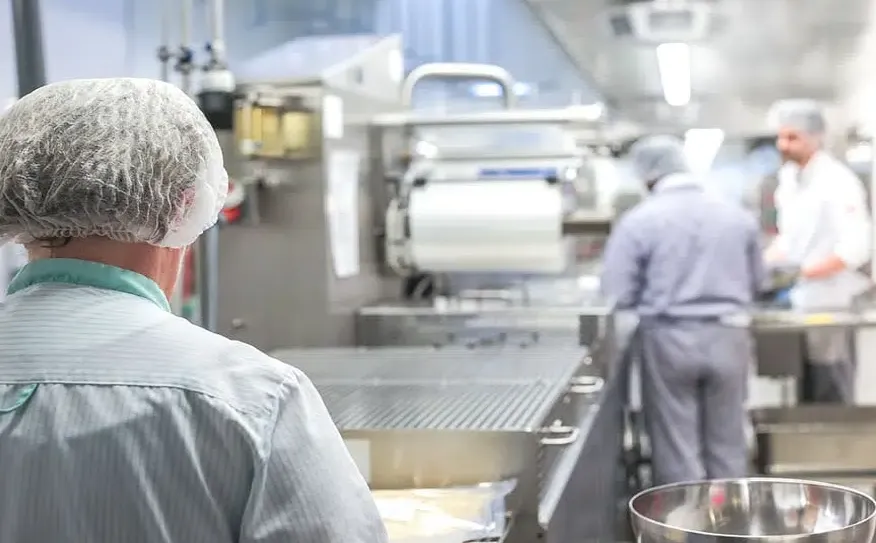
Traditional industrial cleaning—sandblasting, dry ice, and chemical washing—is reaching its limit in the modern food plant. These methods are often slow, create secondary waste, and can wear down expensive stainless steel surfaces over time. Laser cleaning in the food industry offers a non-contact, chemical-free alternative that significantly increases Overall Equipment Effectiveness (OEE) by reducing downtime and eliminating consumables.
The Death of the “Scrub and Rinse” Era
For decades, food processing plants have relied on labor-intensive manual cleaning. However, the 2026 regulatory landscape and rising labor costs are forcing a shift. Mechanical scrubbing creates micro-scratches where bacteria like Listeria can hide. In contrast, laser cleaning uses light to vaporize contaminants without touching the substrate, ensuring a higher level of hygiene with zero mechanical wear.
Comparison: Laser vs. Traditional Methods
| Feature | Laser Cleaning | Dry Ice Blasting | |
| Media/Consumables | None (Electricity only) | High (CO2 pellets) | High (Chemicals/Water) |
| Secondary Waste | Minimal (Captured dust) | None (CO2 gas) | High (Contaminated water) |
| Abrasiveness | Non-contact/Zero wear | Moderate | Corrosive over time |
| Setup Time | Instant | Moderate | Long (Drainage/Masking) |
| Microbial Kill | High (Thermal effect) | Low | High (Bio-sensitive) |
The Physics of Pulse Laser Cleaning
To protect food-grade surfaces, the Pulse Laser Cleaning Machine is the industry standard. Unlike continuous-wave (CW) lasers that generate steady heat, a pulsed system—often utilizing MOPA (Master Oscillator Power Amplifier) technology—delivers high-energy bursts in nanoseconds.
- Ablation: The laser beam hits the contaminant (grease, carbonized sugar, or proteins).
- Vaporization: The contaminant absorbs the energy and instantly turns into gas or plasma.
- Substrate Reflection: The base material (typically 304 or 316 stainless steel) reflects the beam, preventing a Heat-Affected Zone (HAZ) and maintaining the surface’s “bright” finish.
Expert Note: Use MOPA lasers when cleaning delicate molds or polished surfaces. The ability to adjust pulse duration allows for “cool” cleaning, preventing the warping of thin-walled extrusion dies.
Top 4 Benefits for Food Manufacturing Managers
1. Zero Residue Compliance
Laser cleaning leaves no chemical trace. This simplifies HACCP (Hazard Analysis and Critical Control Points) verification since there is no risk of cleaning agent carryover into the food batch.
2. Significant ROI on Consumables
While the initial investment is higher, the Total Cost of Ownership (TCO) is lower. You eliminate the recurring costs of solvents, abrasive media, and water treatment.
- Operational Metric: Typical 200W systems operate at less than $1.50/hour in electricity costs.
3. Precision in Complex Geometry
Cleaning Wobble heads allow the beam to oscillate, effectively “sweeping” residues from deep grooves in baking molds or the intricate links of a conveyor belt without disassembly.
4. Antimicrobial Thermal Shock
The high-intensity light doesn’t just clean; it sanitizes. The localized heat is sufficient to denature bacterial proteins on contact, providing a “deep clean” that mechanical methods miss.
Sector-Specific Use Cases
- Industrial Bakeries: Removing carbonized flour and sugar from baking trays and oven interiors.
- Dairy Processing: Stripping milk stone and protein deposits from heat exchangers and pipes.
- Meat Processing: Blasting fats and oils from stainless steel conveyor rollers.
- Confectionery: Cleaning residual gels and glazes from starch molds.
Compliance and Safety Standards
In 2026, safety is non-negotiable. Industrial lasers are Class 4 devices and require strict adherence to:
- ISO 11553: Safety of machinery – Laser processing machines.
- FDA 21 CFR 1040.10: Performance standards for light-emitting products.
- PPE Requirements: Operators must wear OD6+ rated safety goggles and utilize high-efficiency fume extraction to capture vaporized food particles.
Technical Specification Table: 300W Pulse Laser Machine
| Parameter | Value/Spec |
| Laser Source | IPG or JPT (MOPA) |
| Wavelength | 1064 nm |
| Pulse Energy | up to 12.5 mJ |
| Scanning Speed | 10,000 mm/s |
| Cooling | Air-cooled (up to 300W) |
Conclusion
Laser cleaning is no longer a “future” technology—it is a current necessity for plants targeting high uptime and zero-waste goals. By integrating a Pulse Laser Cleaning Machine into your sanitation cycle, you protect your equipment assets while ensuring the highest level of food safety.